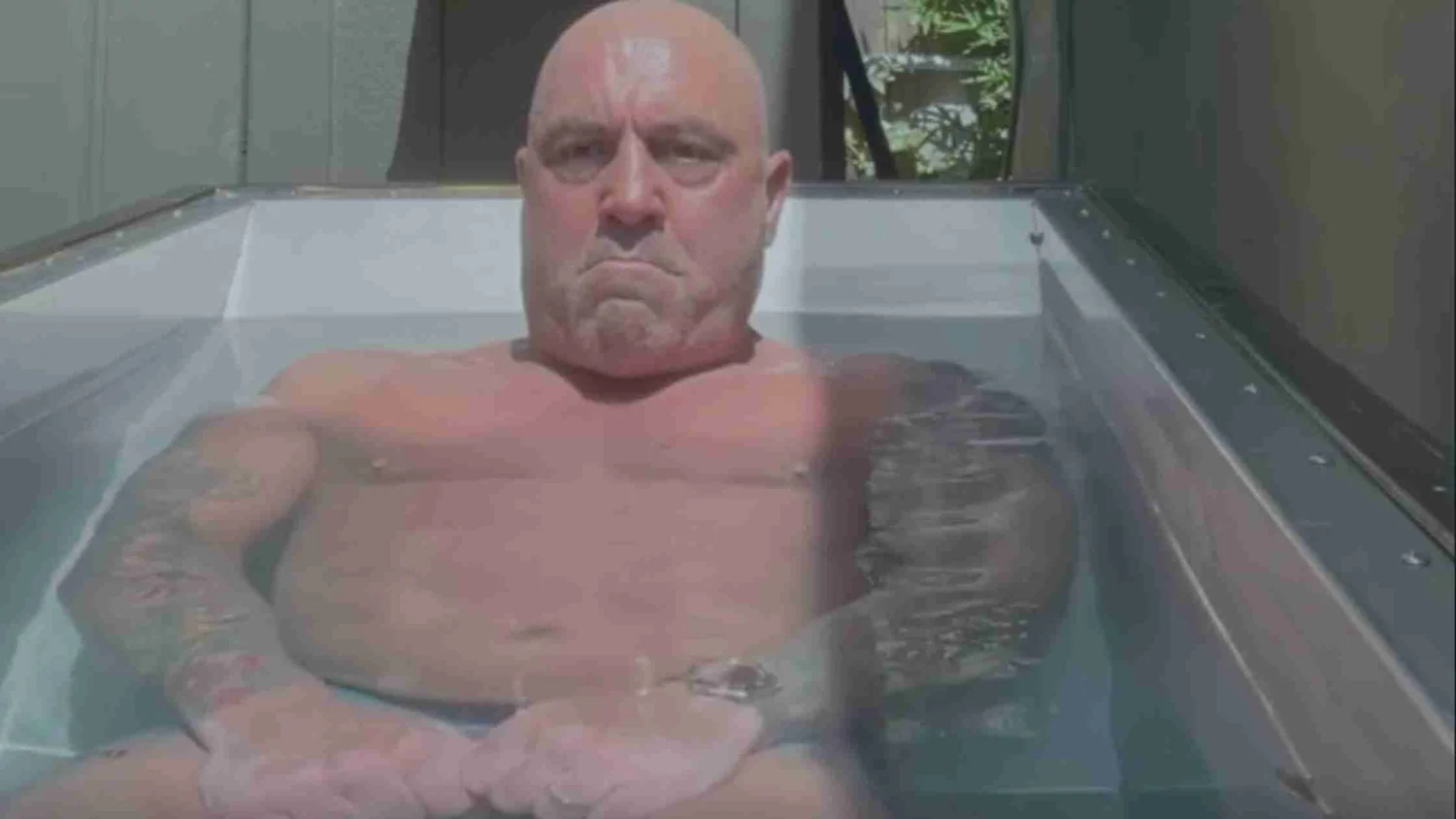
Joe Rogan has probably done more than any mainstream podcaster to make sauna, cold plunge and deliberate heat exposure part of everyday fitness conversation.
But his routine has changed over time — and old articles often blur together traditional saunas, infrared saunas and steam rooms, then turn Rogan’s personal tolerance into a one-size-fits-all protocol.
The clearest relatively recent number comes from JRE #2170 with Max Lugavere. Rogan said that after experimenting with temperatures as high as 205°F, he had backed off and found 185°F for about 20 minutes to be “just uncomfortable enough” for him.
That is the useful answer if you are searching for Joe Rogan’s sauna temperature. It is also important context: he specifically described dialing the heat down after deciding his more extreme sessions were not smart.
Last reviewed: August 29, 2026. This page separates Rogan’s own routine from the actual sauna research and from sauna-company marketing.
Joe Rogan’s sauna routine at a glance
| Question | Best documented answer |
|---|---|
| Temperature | About 185°F in JRE #2170 |
| Time | About 20 minutes |
| Older routine | 180°F for roughly 20–25 minutes |
| Sauna type | High-heat traditional-style sauna is his clearest preference |
| Frequency | Has varied; he reported daily use during quarantine in 2020 |
| Cold plunge | Often pairs heat with cold exposure |
| Should beginners copy it? | No — build heat tolerance gradually |

The current best answer: 185°F for 20 minutes
In JRE #2170, Rogan described his own sauna experimentation in unusually useful detail.
He said he had previously pushed his old studio sauna to around 205°F for 20 minutes, but eventually decided he was overdoing it after experiencing throat irritation and extreme fatigue afterward. His later conclusion was that 185°F for 20 minutes gave him enough heat stress without needing to turn the session into an endurance stunt.
That lines up reasonably well with older JRE discussions. In JRE #1474 with Dr. Rhonda Patrick, Rogan and Patrick both discussed using around 180°F for 25 minutes. Rogan said at the time that he had been doing it daily during the COVID shelter-in-place period.
Read JRE #1474 with Dr. Rhonda Patrick
So what is Joe Rogan’s sauna protocol?
A fair summary is:
Traditional sauna, roughly 180–185°F, for around 20–25 minutes.
But we would not call that his guaranteed daily 2026 routine. Podcast quotes are snapshots, and Rogan has changed his heat/cold habits over time.
Traditional sauna vs. infrared vs. steam room
The old version of this page mixed these together. They are not the same thing.
| Type | How it heats you | Typical experience | Rogan connection |
|---|---|---|---|
| Traditional Finnish-style sauna | Heater warms the room; water may be poured on hot rocks for brief humidity | Hot air, usually relatively dry between water throws | Strongest Rogan connection |
| Infrared sauna | Infrared emitters heat the body/surfaces more directly | Lower air temperature | Rogan has discussed and used infrared, but often says he prefers hotter traditional sauna |
| Steam room | Steam creates very high humidity | Lower temperature but extremely humid | Different environment; not what Rogan means when describing 180–185°F dry sauna sessions |

Traditional Finnish sauna is not simply a “steam sauna.” A Finnish sauna can be fairly dry most of the time, with löyly — water thrown onto hot stones — creating temporary increases in humidity.
That distinction matters because 185°F at low humidity feels completely different from 185°F in saturated steam, which would be dangerously intense.
Why Rogan prefers a hotter traditional sauna
In JRE #1178 with Dr. Rhonda Patrick, Rogan said he preferred a standard high-heat sauna over infrared because he could reach higher temperatures and stronger heat stress more quickly.
He described his sauna reaching 180°F and above, while many infrared units operate closer to 120–150°F.
That does not prove traditional sauna is universally healthier than infrared. It means that if your goal is to recreate Rogan’s own documented routine, a traditional heater that can hold roughly 180°F is the closer match.

What does the science actually say about sauna?
There is a real evidence base here — but it is more nuanced than “sauna makes you live longer.”
1. Cardiovascular associations are the strongest headline
The famous Finnish cohort study followed 2,315 middle-aged men for more than 20 years. More frequent sauna bathing was associated with lower rates of sudden cardiac death, fatal cardiovascular disease and all-cause mortality.
That is interesting and important, but it is still an observational study. People who sauna more frequently may differ from people who sauna less in other ways. It cannot prove that adding four sauna sessions to your week will directly cause the same risk reduction.
Newer Finnish cohort analyses continue to find associations between sauna frequency and cardiovascular outcomes, but the same limitation applies.
2. Sauna clearly creates cardiovascular stress
Sitting in a hot sauna raises skin temperature, increases heart rate, changes blood flow and creates a meaningful thermoregulatory load. In that sense, the body is doing real work while you sit still.
That does not make sauna a replacement for exercise.
Exercise improves muscular strength, aerobic capacity, bone loading, metabolic health and many other systems that passive heat does not reproduce. Rogan and Patrick have both made this distinction in JRE conversations.
3. Intervention evidence is less dramatic than the observational headlines
A 2018 systematic review found potential benefits from regular dry-sauna use but also noted that many studies were small and that better trials were needed.
More recently, a 2025 systematic review/meta-analysis of randomized passive-heating trials found no significant pooled effect for many cardiometabolic outcomes, despite encouraging observational data.
- Clinical Effects of Regular Dry Sauna Bathing — systematic review
- 2025 passive-heating RCT meta-analysis
The evidence is therefore more credible than a wellness fad, but less definitive than some sauna marketing suggests.
What about heat shock proteins?
Heat shock proteins are real cellular stress-response proteins, and heat exposure can activate heat-shock pathways.
This is one reason researchers are interested in sauna and other forms of passive heating. But seeing a molecular mechanism is not the same thing as proving every downstream claim made about longevity, immunity or disease prevention.
A better way to think about it:
Heat stress produces measurable physiological responses. Researchers are still working out which long-term outcomes are caused by those responses and what dose is optimal.
Does sauna “detox” you?
This is one of the weakest recurring claims in sauna marketing.
Yes, you sweat in a sauna. Sweat contains water, electrolytes and tiny quantities of other compounds. But your liver and kidneys are the major organs responsible for processing and eliminating metabolic waste and many toxins.
Sweating heavily does not mean you are performing a deep systemic cleanse.
If you enjoy sauna for relaxation, heat exposure, cardiovascular conditioning or as part of a recovery ritual, those are much more defensible reasons to use it.
Does sauna help workout recovery?
Rogan has repeatedly said that his muscles feel looser and that he feels better after hard training when he uses the sauna.
That personal experience makes sense: heat can feel relaxing, increase local blood flow and reduce the perception of stiffness. But claims such as “sauna dramatically speeds muscle repair” are harder to prove.
The practical benefit may simply be that you feel better and enjoy the ritual enough to keep doing it.
For some athletes, that is valuable even before attaching a biomarker to it.

Joe Rogan’s sauna + cold plunge routine
Rogan frequently combines sauna with cold exposure.
In JRE #2170, he described doing 185°F for 20 minutes, then cold, and sometimes repeating another sauna/cold round when he had time. In JRE #2063 with Dwayne Johnson, they discussed doing sauna and cold plunge sessions around a workout.
This is a Rogan habit, not a requirement for sauna benefits.
You do not need a cold plunge to “activate” sauna. If the contrast feels good and you tolerate it well, it can be an enjoyable ritual. If not, simply cooling down normally is fine.

For more detail, see our Joe Rogan cold plunge guide.
What sauna should you buy to copy Rogan’s setup?
If your goal is specifically to recreate the high-heat JRE experience, look for a traditional electric or wood-heated sauna capable of reliably reaching roughly 175–190°F.
Best match to Rogan’s routine: traditional sauna
Look for:
- A heater sized correctly for the room volume.
- Proper ventilation.
- Sauna-rated wood and electrical components.
- A reliable thermometer.
- Stones designed for the heater if you want löyly.
- Enough bench height to sit in the hotter part of the room.

Shop home traditional saunas on Amazon
Shop sauna thermometers and hygrometers
Easier indoor option: infrared sauna
Infrared can make sense if you:
- Cannot install a full traditional sauna.
- Prefer lower air temperatures.
- Want a plug-in indoor setup.
- Care more about convenient heat exposure than recreating Rogan’s exact protocol.
Shop infrared home saunas on Amazon
Cheapest way to experiment: portable sauna or sauna blanket
A portable sauna or sauna blanket is not the same experience as sitting in a 185°F traditional sauna, but it is a much cheaper way to see whether you actually enjoy deliberate heat exposure before spending thousands on a room-sized unit.
Shop portable saunas on Amazon
Do not compare products by maximum temperature alone. Build quality, electrical safety, comfort, warranty, ventilation and whether you will actually use the thing matter more than winning a spec-sheet heat contest.
How hot should a beginner sauna be?
You do not need to start at 185°F.
Rogan has decades of sauna exposure and has specifically talked about reducing his own temperature after pushing too hard.
A simpler beginner strategy is:
- Start at a temperature that feels hot but manageable.
- Keep the first sessions short.
- Leave before you feel faint, nauseated or confused.
- Increase either time or temperature gradually, not both aggressively at once.
- Rehydrate after heavy sweating.
You are not failing the protocol because someone on a podcast can tolerate more heat than you.
Sauna safety: the part worth taking seriously
Sauna is generally well tolerated by healthy adults when used sensibly, but high heat can cause dehydration, dizziness and blood-pressure changes.
A few practical rules matter:
- Do not combine sauna with heavy alcohol use. Alcohol plus dehydration and heat is a bad combination.
- Drink normally before and after; replace fluids after heavy sweating.
- Leave immediately if you feel faint, confused, nauseated, weak or otherwise unwell.
- Do not turn a sauna session into a willpower contest.
- People with significant cardiovascular disease, unstable medical conditions or medications that affect blood pressure/fluid balance should ask their clinician how heat exposure applies to them.
A review of sauna safety found sauna generally well tolerated, while noting dehydration, hypotension and arrhythmia as concerns in adverse events — especially when sauna was combined with alcohol.
Read the sauna safety review on PubMed
Traditional sauna vs. infrared: which would we choose?
For recreating Joe Rogan’s actual routine, traditional sauna wins.
For ease of installation, infrared may win.
For testing whether you even like deliberate heat, a portable unit or sauna blanket is a much lower-risk financial experiment.
| Goal | Best starting point |
|---|---|
| Copy Rogan’s 180–185°F routine | Traditional sauna |
| Lower-temperature home setup | Infrared sauna |
| Lowest-cost trial | Portable sauna / blanket |
| Strong humidity / steam experience | Steam room — but this is a different modality |
Is a home sauna worth it?
A home sauna makes the most sense when convenience will turn sauna into a consistent habit.
If you already have access to a good gym sauna five minutes away, spending thousands at home may not add much. If you routinely skip sauna because the gym is inconvenient, a home setup can change the economics completely.
Think about the cost per use, not just the purchase price.
A $5,000 sauna used four times a week for five years is roughly $5 per session before electricity and maintenance. The same sauna used twice a month becomes a very expensive storage room.
What we would buy with different budgets
Under $500: portable sauna or sauna blanket, mainly to test the habit.
$1,000–$3,000: entry-level one- or two-person infrared cabin if easy installation matters most.
Higher budget / closest to Rogan: a properly installed traditional Finnish-style electric sauna capable of holding 180°F+ comfortably.
For permanent traditional-sauna installations, electrical load, clearances, ventilation and heater sizing are important enough that we would prioritize a reputable sauna manufacturer/installer over an unknown marketplace brand.
More Joe Rogan recovery guides
- Joe Rogan cold plunge guide
- Joe Rogan Iron Neck guide
- Joe Rogan supplements
- Dr. Rhonda Patrick supplements and JRE guide
- Joe Rogan energy drink
Sources and verification
- JRE #2170 — Max Lugavere: Rogan explains backing off 205°F sessions and settling around 185°F for 20 minutes. Transcript
- JRE #1474 — Dr. Rhonda Patrick: Rogan and Patrick discuss 180°F/25-minute sauna sessions and Rogan’s then-daily use. Transcript
- JRE #1178 — Dr. Rhonda Patrick: discussion of traditional high-heat vs. infrared sauna. Transcript
- JRE #2063 — Dwayne Johnson: sauna/cold-plunge routine around training. Transcript
- JAMA Internal Medicine: Finnish prospective cohort on sauna frequency and mortality. PubMed
- Systematic review of dry sauna bathing: benefits are promising but study quality and size vary. PubMed
- 2025 RCT meta-analysis of passive heating: many pooled cardiometabolic outcomes were not significant. PubMed
- Sauna safety review: discusses sensible use and risks including dehydration/hypotension, particularly with alcohol. PubMed
Editorial note: Rogan’s personal protocol is not a medical recommendation. Sauna temperature, humidity, individual heat tolerance and health status all change the physiological load.