Joe Rogan talking about the Iron Neck is not one of those internet associations where a product appears in the background once and suddenly twenty affiliate sites claim it is his favorite thing on earth.
He has actually talked about it, recommended it and explained why he prefers it to old-school neck bridges and hanging plates off your head.
The real question is not whether Rogan likes it. He clearly does.
The real question is whether you need a $349–$599 neck-training device.
Quick answer: if you train BJJ, MMA, wrestling, football, rugby or another sport where your head and neck get loaded constantly, Iron Neck is a smart, very well-designed tool. If you are a casual gym user who just thinks neck training might be good, start with bands or a cheap harness first.
Joe Rogan’s Iron Neck at a glance
| Question | Answer |
|---|---|
| Does Rogan really use it? | Yes, documented repeatedly on JRE |
| Current models | Iron Neck 3.0 and 3.0 Pro |
| Regular manufacturer price | $349 / $599 |
| Main Pro upgrade | Adjustable rotational resistance |
| Best use case | Combat and contact sports, serious neck training |
| Biggest downside | It is expensive for one body part |
| Does it prevent concussions? | Not proven |
| Best budget alternative | Neck harness + resistance bands |
Check current Iron Neck listings on Amazon
What Joe Rogan has actually said about Iron Neck
One of the clearest conversations is JRE #1735 with Peter Attia.
Rogan asks Attia about neck strength and explains the Iron Neck as a fitted halo-style device connected to resistance. The important part of the conversation is why he likes it: he can load the neck while moving under controlled tension instead of putting his body weight directly on his head in a wrestler’s bridge.
That is a pretty rational reason to like the product.
He recommends it again in the JRE MMA Show #147 with Sean O’Malley and Tim Welch when neck strength and posture come up.
What the Iron Neck actually does
Strip away the marketing and it is a very clever resistance system for your neck.
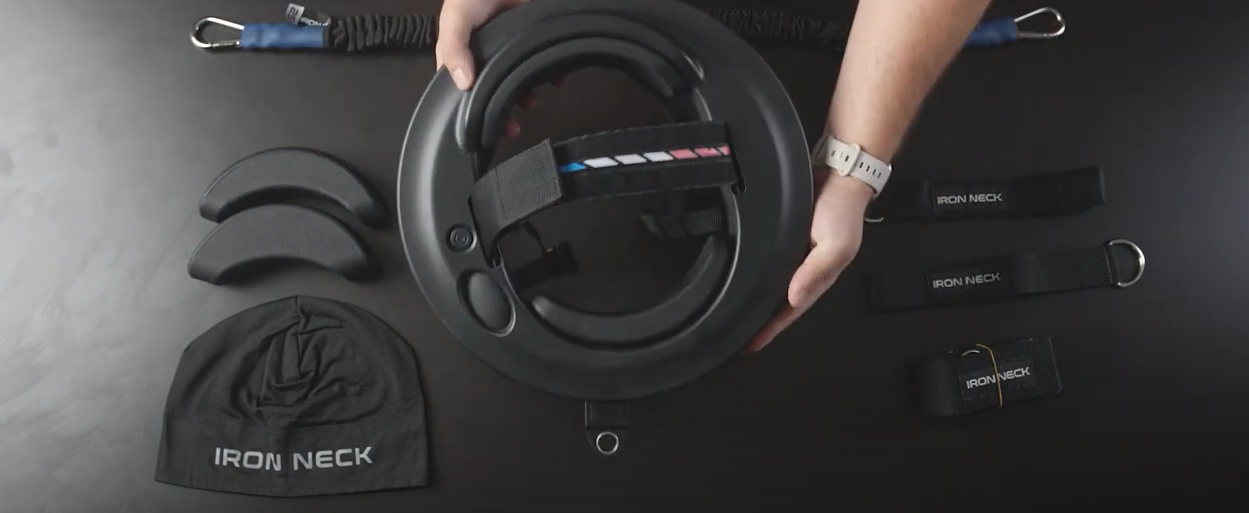
The headpiece fits securely around your head. A resistance band connects the unit to an anchor. You change your body position, then resist or move against the pull from different directions.
That gives you something a basic neck harness does not do nearly as elegantly: multidirectional loading.
You can train:
- flexion and extension
- lateral stability
- isometric holds
- controlled rotation
- resisting force from changing angles
That is why the product makes so much sense for grappling. Nobody in a front headlock applies force to your neck in one perfect gym-machine plane.
Iron Neck 3.0 vs. 3.0 Pro
This is the decision most buyers actually need help with.
| Feature | Iron Neck 3.0 | Iron Neck 3.0 Pro |
|---|---|---|
| 360° movement | Yes | Yes |
| Linear band resistance | Yes | Yes |
| AirFit-style fitted headpiece | Yes | Yes |
| Door / rack anchors | Yes | Yes |
| 25 lb resistance band included | Yes | Yes |
| Adjustable rotational resistance | No | Yes |
| Variable friction dial | No | Yes |
| Regular price | $349 | $599 |
| Who should buy it? | Most people | Athletes who specifically need resisted rotation |
Iron Neck’s current 3.0 vs. 3.0 Pro comparison says the defining difference is the Pro’s rotational resistance and variable friction dial. Both include the core headpiece, linear resistance and anchor setup.
Which one would we buy?
Iron Neck 3.0 for most people.
You are already getting the big upgrade over a normal harness: a secure headpiece and easy multidirectional band loading.
The 3.0 Pro makes sense if you can explain exactly why adjustable resisted rotation belongs in your program. Fighters, wrestlers, motorsports athletes and coaches may have a very good answer to that.
If your answer is “the Pro is better because it costs more,” save the $250.
The price changes a lot, so do not trust old articles
Iron Neck regularly runs sales.
At the time we checked on September 6, 2026, the manufacturer showed the 3.0 at $299 sale / $349 regular and the Pro at $499 sale / $599 regular on parts of its current storefront. Other live storefront variants showed regular pricing, which is exactly why hard-coding a sale price into an evergreen guide is a bad idea.
Our advice:
Judge the product at the regular price. Treat any sale as a bonus.
Check Iron Neck’s current pricing
Who should actually buy an Iron Neck?
BJJ and MMA athletes
This is probably the cleanest fit.
In grappling, the neck is constantly resisting:
- collar ties
- snap-downs
- crossfaces
- front headlocks
- guillotines
- head-and-arm control
- awkward rotational force
A stronger neck will not make you submission-proof. But it is easy to understand why deliberately training the area can make sense when your sport repeatedly loads it.
Wrestlers and contact-sport athletes
Same basic logic. The neck is part of the kinetic chain and gets exposed to force from weird angles.
Iron Neck’s advantage is not magic. It is that the setup makes consistent, controlled training easier.
Motorsports athletes
This is a less obvious but legitimate use case. Drivers can experience repeated lateral loading, and neck endurance matters when the head and helmet are being pulled around by G-forces.
Coaches and gyms
The value proposition changes when ten or twenty athletes use one device.
A $599 tool sitting in one person’s closet is expensive. A $599 tool integrated into a team training program is a different calculation.
Who probably does not need one
You probably do not need an Iron Neck if:
- you have never trained your neck before
- your main goal is “better posture”
- you are hoping it fixes unexplained chronic pain
- you saw Rogan use one and want another piece of home-gym gear
- you are inconsistent with basic strength training already
There is no point owning the world’s fanciest neck trainer if you do not use it.
Does neck training work?
For the basic question “can resistance training make your neck stronger?”, yes.
A 2024 systematic review and meta-analysis found a substantial effect of exercise interventions on isometric neck strength. That is the strongest, least controversial reason to train the neck.
The problem is what happens next in marketing:
stronger neck → therefore fewer concussions → therefore buy this device.
That chain is not established nearly well enough.
Does a stronger neck prevent concussions?
Maybe in some contexts. Not reliably enough to promise it.
A 2023 systematic review found the evidence connecting greater neck strength with reduced sports-related concussion risk to be very low certainty, with the pooled relationship small and not statistically convincing.
A newer review in 2026 still described the overall relationship as inconclusive.
So the useful position is:
Train your neck because having a stronger neck can be useful. Do not pretend you bought concussion armor.
Technique, rules, exposure, impact forces, medical protocols and appropriate protective equipment still matter.
Iron Neck vs. a $40 neck harness
This comparison is more useful than pretending everyone needs the premium device.
| Iron Neck | Basic neck harness | |
|---|---|---|
| Price | High | Low |
| Setup comfort | Excellent | Basic |
| Multidirectional work | Excellent | Limited |
| Rotation | Excellent on Pro | Awkward |
| Simple flexion/extension | Excellent | Also excellent |
| Portability | Good | Excellent |
| Beginner value | Medium | High |
| Best fit | Serious, repeatable neck program | Cheap basic strengthening |
Shop resistance bands with anchors
A cheap harness is not as polished. Your neck muscles also do not know how expensive your equipment is.
If basic resistance gets you training consistently, that is a win.
A sane way to start neck training
The neck is a terrible place to bring the “more weight at all costs” mentality.
A better progression:
- Start with isometrics. Learn to create tension without jerking your head around.
- Use low resistance. The goal is control, not proving your neck is strong on day one.
- Train multiple directions. Flexion, extension and lateral stability all matter.
- Add rotation carefully. Especially under load.
- Progress slowly. More resistance, range or duration should be earned over time.
Stop and get evaluated for numbness, tingling, weakness, radiating pain, unusual headache, dizziness or symptoms after significant trauma.
Can Iron Neck fix neck pain?
Do not buy a device as a diagnosis.
Neck pain can come from muscular load tolerance, joints, discs, nerves, headache disorders, prior trauma and a pile of other causes. Resistance exercise can absolutely be part of rehabilitation for some people, but that does not mean one product fixes every neck problem.
Iron Neck’s own clinical page makes broad claims around mobility, discomfort and posture. Those are manufacturer claims and should not be confused with a personalized medical assessment.
If you have persistent or neurological symptoms, get the problem assessed before you start loading it harder.
Can Iron Neck fix posture?
It can strengthen muscles involved in supporting and controlling the head. That is useful.
But posture is not a single broken position you cure by making your neck stronger. Desk time, upper-back strength, movement variety, fatigue, vision, ergonomics and pain all matter.
If your only complaint is “I slouch at my computer,” start with basic strength training and more movement before spending hundreds on specialized gear.
Our buying recommendation
Best for most buyers: Iron Neck 3.0
You get the core system without paying for the Pro’s friction-based rotational resistance.
Best for serious combat/contact sport use: Iron Neck 3.0 Pro
Buy it when resisted rotation is a real programming need, not because it has “Pro” in the name.
Best budget option: harness + bands
If you have never trained your neck, this is where we would start.
Compare Iron Neck listings on Amazon
Browse budget neck-training equipment
More Rogan training and recovery guides
- Joe Rogan cold plunge routine
- Joe Rogan sauna routine
- Joe Rogan supplements
- Joe Rogan podcast equipment
- Joe Rogan energy drink
Sources and verification
- JRE #1735 — Peter Attia: direct Iron Neck discussion. Transcript
- JRE MMA Show #147 — Sean O’Malley & Tim Welch: Rogan recommends the device. Transcript
- Iron Neck: current model comparison and pricing. 3.0 and 3.0 Pro
- British Journal of Sports Medicine: neck-strength exercise review. PubMed
- JOSPT: neck strength and concussion risk review. PubMed
- Current Sports Medicine Reports (2026): newer concussion-risk review. PubMed
Bottom line
Iron Neck is a legitimately good piece of equipment. It is also a piece of equipment for one relatively small area of your body, and it costs as much as some people’s entire garage-gym setup.
If you grapple, fight, wrestle or have a real reason to train your neck seriously, it makes a lot of sense.
If you are just curious, buy bands or a harness first. Prove you will actually train your neck. Then buy the expensive thing.